
Glossary
Legal jargon can be difficult to understand if you have never needed it before. Below are basic definitions of commonly used legal terms.
DISCLAIMER: This is not a comprehensive glossary. And the meaning of legal terms can change as courts make rulings that change them. If you are currently involved in a legal matter that turns on the accuracy of these definitions, please refer to the cases published on CanLII for more current definitions.
Affidavit
An Affidavit (Form 49) is the sworn statement of a witness in written form. Affidavit is often used when parties are making applications to the court in advance of a trial.
Sometimes a judge will permit a witness to give evidence by Affidavit instead of appearing in person to given evidence at trial if the witness is otherwise unavailable (deceased, out of the country, lacking capacity, etc.),
but generally courts like witnesses at trial to be available to testify in person so they can be cross-examined on their evidence by the oher parties.
Alberta Rules of Court
Alberta's courts are governed by the Judicature Act, RSA 2000, c J-2. And the Alberta Rules of Court, AlB Reg 124/2010 are enacted by a regulation under that statute.
In addition to the Act and the Regs, court processes are also governed by Practice Notes issued by the courts from time to time.
Evidence
Evidence is how you are going to prove your claim against the other party. You should have some evidence for each claim you are advancing in your case.
Evidence can be in almost any form (witness testimony, documents, audiovisual recordings, etc.) but it always has to be admitted through a witness who will testify about how the evidence came into existence and how it relates to your case.
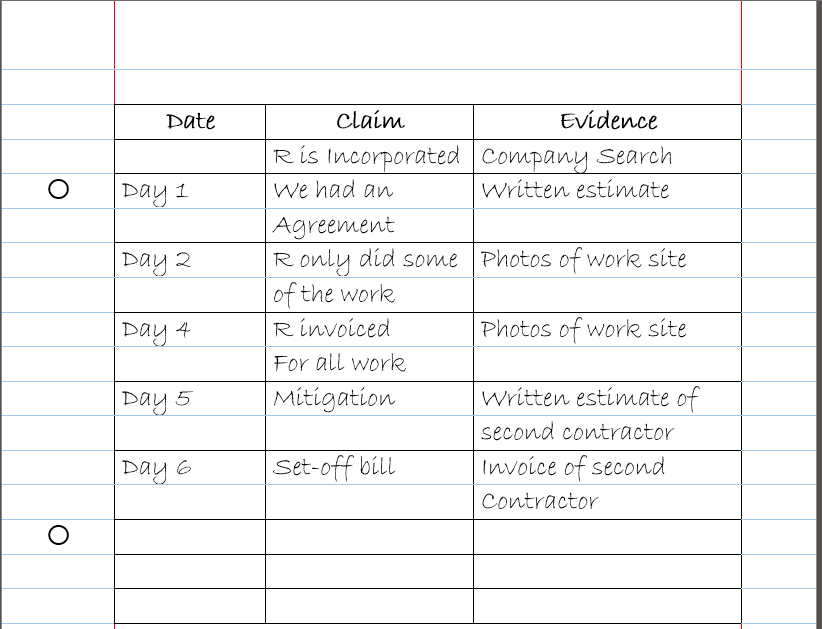
Put all the evidence of your case into a table like the one above to ensure that each claim you are making can be proven.
Expert Witnesses
Expert witnesses are those who have some specialized skills or knowledge that the court relies on to better understand the case.
Only expert witnesses are allowed to speculate about how an event might have happened, without having personal first-hand knowledge about an event.
Expert witnesses must be accepted as experts in the field in which they are going to testify in order for the court to defer to their expertise. It helps if another court has already qualified the witness as an expert in that particular field, but prior qualification will not necessarily mean that the judge in your case will qualify the witness as an expert.
Injunction
An injunction is a court order that stops a party from doing something. Injunctions can be obtained to stop actions that are already happening, or to prevent actions that my happen in the future.
Pleadings
Pleadings are a concise outline of your case and they are different from Evidence (see above).
Each party to a court case will file their own pleadings. The Claimant will file a Statement of Claim, and a Defendant will file a Statement of Defence. You can find those forms here.
Pleadings start by identifying the parties that will be involved in the litigation.
Then they explain the relationship of the parties to each other.
Then they explain the nature of the dispute between the parties.
Then they explain what relief that party is seeking from the court.
Include only those elements in your pleadings that are necessary to prove your claim(s). Pleadings are meant to be an outline, not a detailed explanation of your case.
Pre-Trial Applications
If a party needs something from the other party that they are not providing, or if a party needs guidance of the court about how to solve a specific problem in preparing for trial, that party can make an Application (Form 27) to the court in advance of the trial.
Reply to a Statement of Defence
If the Defendant has made new claims in the Statement of Defence, the Plaintiff can respond to these claims by filing a Reply.
Service
Both parties have limited time periods within with they must take the next step in the court case. In order to start the clock ticking on the opposing party's time period, you must prove to the court that they were served with your claim on a certain date.
This is done by filing an Affidavit of Service with the court.
Statement of Claim
A Statement of Claim (Form 10) is one of two type of Pleadings (see above). The other is a Statement of Defence (see below).
Only a Plaintiff (the person who has started the court case) will file a Statement of Claim.
Pleadings start by identifying the parties that will be involved in the litigation.
- The plaintiff is a school teacher who ordinarily resides at 123 Main St, Small Town, AB (the "Plaintiff").
- The defendant, Company XYZ is a company duly incorporated under the laws of Canada and continued into Alberta under registration no. 12345678 (the "Defendant").
Then they explain the relationship of the parties to each other.
The Defendant contracted with the Plaintiff to provide the following services:
--> service 1;
--> service 2; and
--> service 3
and to invoice the Plaintiff upon the completion of these services (the "Agreement").
Then they explain the nature of the dispute between the parties.
The Defendant completed services 1 and 2 but did not complete service 3 before invoicing the Plaintiff; and
The Defendant has been sold to a new owner who refuses to honour the Agreement between the
Defendant and the Plaintiff.
Then they explain what relief the Plaintiff is seeking.
The Plaintiff has already arranged with Company ABC to complete service 3 and been charged $X dollars for
that service.
Therefore, the Plaintiff seeks to have the Defendant's invoice reduced by this amount.
ALL OF WHICH IS RESPECTFULLY SUBMITTED.
Include only those elements in your pleadings that are necessary to prove your claim. Pleadings are meant to be an outline, not a detailed explanation of your case.
Statement of Defence
A Statement of Defence (Form 11) is one of two type of Pleadings (see above). The other is a Statement of Claim (see above).
Only a Defendant (the person who is being sued) will file a Statement of Defence.
Pleadings start by identifying the parties that will be involved in the litigation. If the Plaintiff has correctly identified the parties in the Statement of Claim, the Defendant can agree that the parties are correctly identified. But if there is a dispute about the identity of the parties, this is the place to set out that dispute.
The particulars of the Plaintiff are correctly set out in the Statement of Claim (the "Plaintiff").
Company XYZ LTD. WAS a company duly incorporated under the laws of Canada and continued into Alberta
under registration no. 12345678.
Company XYZ LTD has gone bankrupt, and Company XYZ INC. (the "Defendant") purchased the assets of
Company XYZ LTD from its receiver.
The Defendant then explain their understanding of the relationship of the parties to each other.
The Defendant purchase the contract with the Plaintiff from the receiver (the "Agreement").
The Defendant has not performed any services for the Plaintiff, nor has the Defendant invoiced the Plaintiff.
The Defendant has no knowledge of any verbal agreements between the Plaintiff and the bankrupt company,
and relies wholly on the Agreement as written.
Then they explain the nature of the dispute between the parties.
The Defendant has demanded payment from the Plaintiff and the Plaintiff has refused, neglected, or otherwise
failed to pay the amounts due.
Then they explain what relief the Plaintiff is seeking.
The Defendant seeks payment from the Plaintiff in the full amount of the original invoice.
ALL OF WHICH IS RESPECTFULLY SUBMITTED.
Include only those elements in your pleadings that are necessary to prove your claim. Pleadings are meant to be an outline, not a detailed explanation of your case.
Witnesses
Witnesses are individuals who have evidence that is relevant to your case.
They may have been present when an event happened, and have personal knowledge of events, but they may also be expert witnesses who have drawn conclusions based on the facts that you provided (like an accident reconstruction expert might do).
Still need help? Contact us using the link below, or book an intake appointment to discuss your file.
Last Updated: 26Mar20